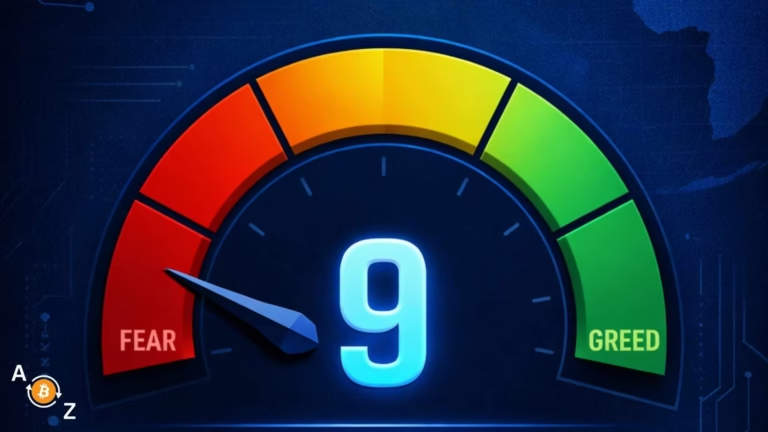


Bitcoin is expected to make a new all-time high in Q2 of 2026 (April to June) amid rising expectations of a lower interest rate by the US Federal Reserve under a new Chairman. We expect a price of $150,000 in Q3 and $200,000 by year-end.
Table of Contents
Current State of Bitcoin Markets
Bitcoin has been in a short-term bear market (also called a sharp correction) since October 2026.
Although several factors are being cited as reasons for the collapse, such as Binance’s Ethena USDe 20% yield program, short positions by market participants, institutional selling, etc., the main reason for the crash remains a liquidity crunch that has been troubling the markets since 2023.
This crunch was addressed in the short term (between Nov 2025 and October 2026) by institutions re-routing cash from traditional markets into Bitcoin Treasuries. However, this could not sustain the price as Gold began a very sharp rally, and institutional money, including that of crypto-native companies, was routed into Gold.
Technical Analysis
Bitcoin has seen a rapid price slide since October 10, 2025, due to general market corrections following a peak. The price has since slid down to a low of $60,000.
The price has been moving in a wide descending channel since October 10, and this descending channel ended in February 2026.
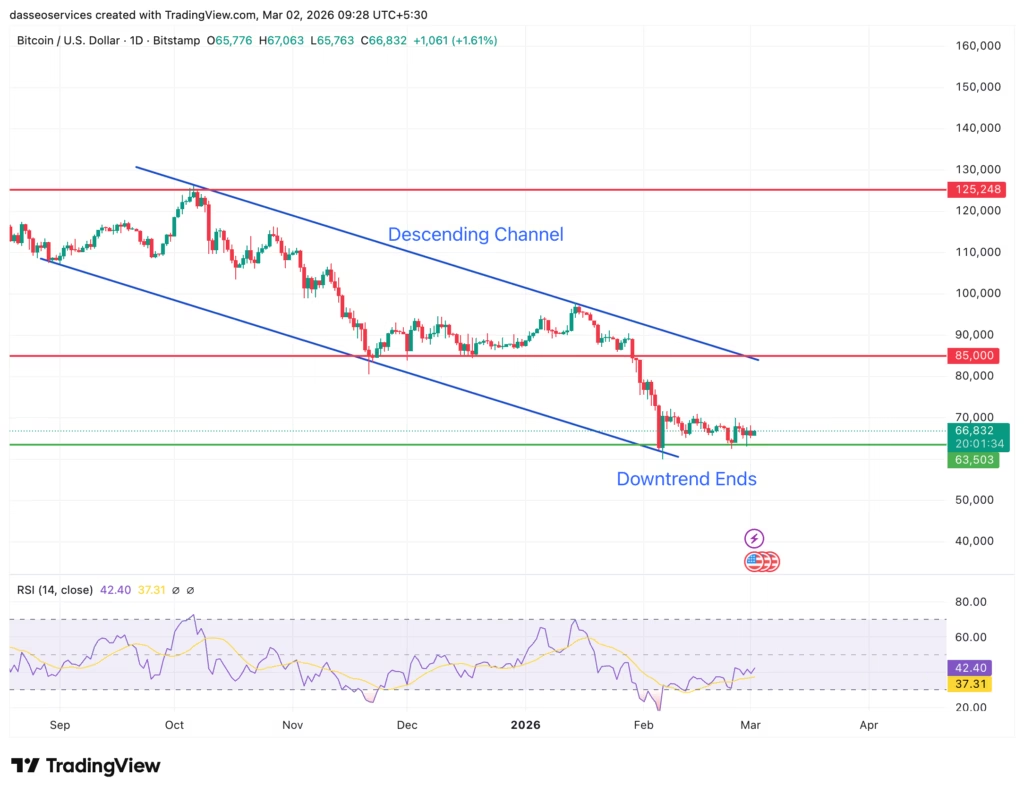
At present, there is a very strong support zone at $60,000, which is not expected to break due to fundamental factors (explained below) and a strong buying zone around this level.
However, it is not expected to go further down due to a strong buying zone between $60,000 and $65,000, which was confirmed when Bitcoin did not sustain a price below $65,000 despite the Middle East war breaking out in the first week of March 2026.
Fundamental Factors
Bitcoin’s current market strength stems from strong fundamentals, including demand, adoption, expanded use cases, its role as a substitute for both Gold and Fiat, and other factors, as shown below.
Factors Working in Support of Bitcoin
Institutional and Retail Adoption
Bitcoin has seen widespread institutional adoption in three major ways:
- Bitcoin ETFs, which hold approximately 1.275 million BTC.
- Bitcoin Treasuries, which hold approximately 1.137 million BTC.
- Private Bitcoin holdings of companies either via Bitcoin-related stock like MSTR, or via investment funds, wealth funds, sovereign funds, etc.
De-Dollarization
The value of the US Dollar has been in a consistent decline since the 1900s. However, the decline has accelerated further since 2020 due to the sheer quantum of debt being taken by the US Government.
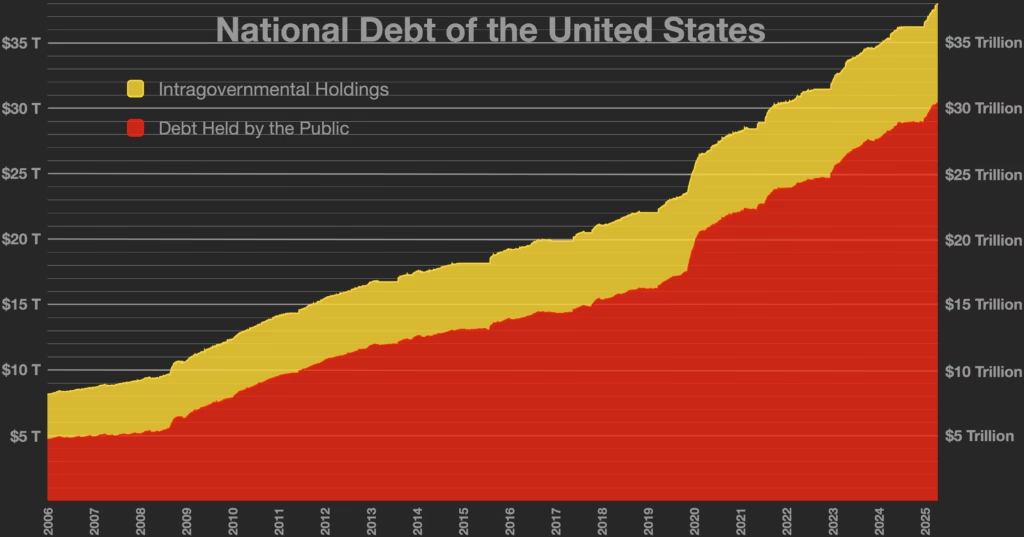
A declining dollar has led to wealth erosion not only in fiat currency but also in stablecoins. As a result, people have switched to buying Bitcoins. In 2025 alone, Morgan Stanley estimates a 10-11% decline. The establishment of Bitcoin Treasuries by various companies signifies the same.
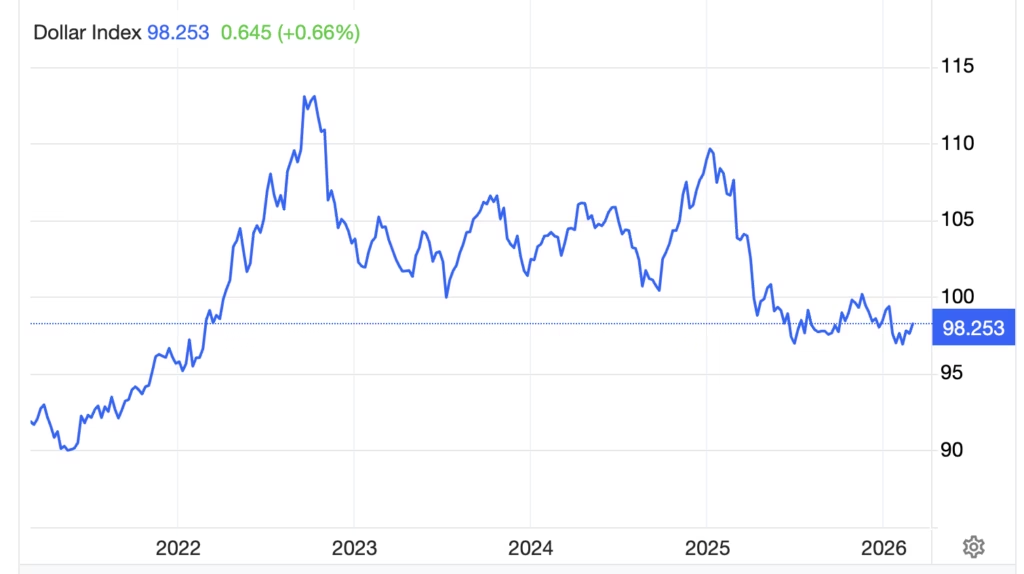
Source: https://tradingeconomics.com/united-states/currency
Gold Substitute
Bitcoin has now gained mainstream adoption as a substitute for Gold with several new countries adding it to their asset reserves.
- United States
- China
- United Kingdom
- Ukraine
- Bhutan
- El Salvador
- Finland
- Georgia
- Venezuela
- North Korea
Germany previously held Bitcoins but sold them in 2024, bringing its reserves down to zero.
International Trade Settlements
Several large economies have been using Bitcoin to settle trade balances between them due to their differences with US-led world trade. Among these, two prominent countries are Russia and Iran with possibility of North Korea being one too.
Long-Term Holding Patterns
Bitcoin investors tend to hold their investments for longer time than others. These investors have supported the price of Bitcoin in its worst phase and continue to support by holding on to their assets.
Factors Working Against Bitcoin
Stringent Regulations and High Taxes
Globally, regulators have been slow in terms of Bitcoin adoption despite the tech industry and finance industry welcoming it with open arms. IMF, which once stated stablecoins as a financial risk as early as 2025, now advocates for them in its report.
Further Reading: IMF Endorses Stablecoins, Discourages Bitcoin, All Major Stablecoin Issuers Hold Bitcoin
Yet, several countries like India, the Netherlands, and other EU nations have put high rates of taxes on cryptocurrencies.
Fence Sitters
Among institutions that have recently acquired Bitcoin, several fence sitters are ready to sell at the slightest hint of an upcoming correction. These institutions create additional risk for Bitcoin’s price when market liquidity is low.
Risk Considerations
Over-supply Risk
During bear markets, Bitcoin gets a lot more volatile. Those who are unable to handle this volatility in their accounts tend to sell. As the number of sellers grow, Bitcoin sees an excessive supply in the markets causing prices to fall.
One such similar incident was seen between October 2025 and Jan 2026 when Bitcoin corrected almost 46%.
This risk can be hedged by taking contra market position via options which saves your capital irrespective of the direction of the markets.
Volatility Risk
Volatility Risk is seen when the price of an asset makes wild swings on either side, i.e., rising and falling rapidly due to some uncertainity in the market. Here, prices could gain or correct or do both to the tune of 10% or even more. Such wild swings are difficult to take for the average market participant and they end up selling the asset.
Market Liquidity Risk
Although this has never been seen for Bitcoin but liquidity risks are present across all assets. This happens when you want to buy or sell your assets but do not find a matching buyer who is willing to buy or sell at current market price.
Quarterly Price Prediction for 2026
Summary
Bitcoin isnt expected to fall below $60,000 in 2026. On the upside, it is expected to ross $200,000 by the end of the year.
Jan-Mar
Bitcoin is expected to remain between $60,000 and $70,000 in this period because of liquidity concerns, the rally in Gold prices, and the uncertainity around crypto regulations across the globe.
April-June
The US Federal Reserve is expected to cut down rates under its new chairman to align with the goals of the US President and Department of Treasury.
If a major rate cut above 1% takes place in this quarter, we could see Bitcoin making a new ATH above $126,000.
Policy meeting dates are on April 28-29, and June 16-17.
July-Dec
The second half of the year could see further accelerated growth in Bitcoin as prices are expected to soar past $200,000 due to multiple factors.
- Increased buying of BTC by institutions.
- Increased retail adoption due to Bitcoin being a substitute of Gold, sometimes referred to as the Digital Gold. Another cause for retain adoption is the sliding value of the US Dollar.
Frequently Asked Questions
Which crypto will boom in 2026?
Most cryptocurrencies in the bluechip category(i.e., top 50)are expected to boom due to an expected series of rate cuts by the US Federal Reserve.
Which business leaders believe in Bitcoin?
Top Bitcoin maximalists include Michael Saylor, Brian Armstrong, Changpeng Zhao, Larry Fink, and firms like BlackRock, Goldman Sachs, Bitmine, etc.